Recuva - An Easy Way to Recover Deleted Files
Recuva is effective software for recovering accidentally or intentionally deleted (lost) files on computer hard drives, as well as on removable media.

Recuva is simple but effective data recovery software. It doesn't matter where the files were or in what format. The tool automatically displays all lost objects. You only need to specify the disk and the type of analysis. Supported file systems include ntfs, fat, fat32, exfat, etc.
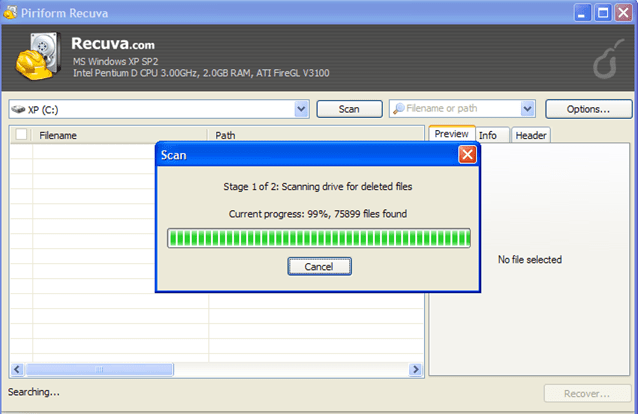
Recuva will help you recover deleted files from the Recycle Bin, individual folders, and restore information that was on removable media, portable drives: ext4, ext3 partitions from digital cameras, mobile phones, etc.
At first glance, a basic deleted file recovery software is capable of bringing order even to a superficially formatted hard drive. So with its functionality, recovering accidentally deleted files won't be too difficult. But that's not all. Recuva can not only recover deleted files but also permanently delete unnecessary information and remnants of found files.
Please note that the sooner you start using Recuva, the more likely you are to recover all your files. You should not install the application on the same drive where the data was deleted. Overwrites may occur in the clusters, and your accidentally deleted photos, unsaved documents, or other damaged data may disappear forever.
Lesser-Known Features of Recuva:
Folder Structure Recovery
Recuva not only finds individual files but also restores the original tree-like folder structure, including nested subfolders. This is crucial when working with projects where the organizational hierarchy is important.
Advanced MFT Handling
The program performs a deep analysis of the NTFS Master File Table, recovering data even when the MFT is partially damaged. This method allows file recovery when other tools are powerless.
Virtual RAID Reconstruction
Recuva allows you to create virtual RAID arrays from individual disk images, enabling data recovery from damaged RAID systems without the need for physical reconstruction.
Cluster Analysis
A sector-by-sector scan mode with manual clustering parameter settings allows file recovery in the most challenging cases where standard methods fail.
Metadata Recovery
Preserves not only file contents but also all attributes: creation and modification timestamps, NTFS access permissions, and attributes of hidden and system files.
Extended Signature Database
The database contains over 2000 unique file signatures, including specialized CAD system formats, scientific data, and rare media formats unavailable in other programs.
Email Recovery
Specialized algorithms recover not only Outlook PST and OST files but also preserve the internal structure of emails, attachments, and system folders.
Support for Exotic File Systems
Through a plugin architecture, it supports ReFS, HFS+, Ext2/3/4, and other niche file systems used in specialized devices.
Recovery from Memory Images
Analysis of RAM dumps and page files allows extraction of temporary data, cached passwords, and unsaved documents that were never written to disk.
File Erasure:
Method 1: Simple One-Pass Overwrite
This method performs a single overwrite of sectors containing deleted data. The erasure principle is based on filling sectors with zeros (0x00) or random data. In the Recuva interface, this method is labeled as Simple overwrite (1 pass). The technical implementation involves direct access to the disk clusters where the file data was previously stored, followed by their complete replacement. This approach effectively prevents data recovery by standard means and software tools but may be vulnerable to specialized hardware analysis methods.
Method 2: DoD 5220.22-M Standard (3 passes)
The algorithm complies with the US Department of Defense standard and implements a three-stage overwrite process. The erasure principle consists of sequential execution: first pass - writing zeros (0x00), second pass - writing ones (0xFF), third pass - writing random data followed by result verification. In Recuva, this method is activated via the secure deletion settings. The technical feature of this method is its combined approach, which eliminates the possibility of data recovery even in the presence of residual magnetic traces on traditional hard disk drives.
Method 3: NSA R7 Method
Standard deletion in Windows only marks data as deleted in the MFT, leaving it physically intact. For guaranteed information destruction, Recuva implements the NSA R7 algorithm, designed for magnetic drives. The method includes seven overwrite cycles: sequentially filling sectors with ones (0xFF), zeros (0x00), two pseudo-random sequences, and complementary patterns followed by verification. Multiple alternations of deterministic and random patterns prevent data recovery, including methods of analyzing residual magnetization. The algorithm is not used for solid-state drives due to architectural features of wear-leveling, which require the use of the ATA Secure Erase command.
Method 4: Gutmann Algorithm (35 passes)
Developed by Peter Gutmann, this method uses 35 overwrite cycles with different data patterns. The erasure principle is based on using specially designed sequences intended to neutralize various encoding technologies used in older drive models. In Recuva, this method is available through advanced secure deletion settings. The technical implementation involves alternating patterns specifically designed to counter the possibilities of microscopic analysis of magnetic surfaces. For modern drives, this method is considered excessive but remains relevant when working with legacy equipment.
Features of Recuva
- Recovers information from the Recycle Bin, flash drives, memory cards, and other devices;
- Supports a large number of memory cards: Secure Digital, MemoryStick, Sony Memory Sticks, Smart Media, and many others;
- Recovers damaged and formatted disks after software failure;
- Manages all types of deleted files, from images to music and video;
- Completely deletes unnecessary information without the possibility of recovery.
Benefits of Recuva
- Intuitive and simple user interface in English;
- Smart analysis of lost files;
- Deep scanning of the file system;
- Convenient search by title, as well as by file extension;
- Recovers deleted files from Windows 10 and 11, compatible with older Windows XP and Vista.
Disadvantages
- Only works on Windows, cannot recover files from Mac OS;
- Low probability of repairing damaged file drives.
How to Use Recuva
When Recuva starts, it offers the user the ability to customize the search options for the data they need.
- In the first window, select the type of data, the same format - images, video, music, files, emails, Word and Excel documents, or files of all types. Click Next.
- The next window allows you to choose where the files are located: on a memory card or other removable media, in documents, in the Recycle Bin, or in a specific location on the disk. If you don't know where to look for a file, select I'm not sure.
- Recuva is now ready to search. Before starting, you can enable the deep scan function, but it will take longer. It is recommended to use this function when the search is unsuccessful. Click Start.
- In front of you is a list of found data. A green circle next to the name means the file is ready to be recovered, a yellow one means the file is damaged, and a red one means the file cannot be recovered. Check the box next to the desired file and click Recover.
- Select the folder on your hard drive where you want to save the data.
Recuva's History
The Idea's Origin and Developer
Recuva was created by the British company Piriform Ltd., founded in 2004. The name Piriform comes from the Latin word "pirus" (pear), which is reflected in the company's logo. The founders were programmers who aimed to create lightweight, efficient, and free software for everyday users. Before Recuva, they had already created the popular program CCleaner.
Reason for Creation
By the mid-2000s, CCleaner had become a popular system cleaning tool. However, useful files were sometimes accidentally deleted during cleaning. Users constantly asked on forums how to recover files deleted by CCleaner. The Piriform team recognized the need for a simple and accessible data recovery tool. Thus, the idea for Recuva was born.
Technical Foundation
Recuva is written in the C++ programming language, which ensures high performance for disk operations, direct access to Windows API, and compact executable files. The interface was created using the wxWidgets library.
First Versions (2007-2008)
The first version of Recuva was released in November 2007 as free-for-non-commercial-use software. It could recover files from hard drives, memory cards, and USB drives, featured simple and advanced scan modes, a file status indicator, and a secure file deletion function.
Significant Updates (2009-2013)
In 2009, the Deep Scan feature was introduced, which searched for files by their signatures directly in the disk clusters. Subsequent versions added support for 64-bit systems, improved the interface, added a virtual folder for displaying files, and enhanced work with network drives.
The Avast Era and Continued Support
In 2017, Piriform was acquired by Avast Software. After this, the pace of major updates slowed, with primary efforts focused on maintaining compatibility with new Windows versions and fixing vulnerabilities.
Reasons for Popularity
Recuva's success is attributed to its simple interface, a free version without restrictions, effective data recovery capabilities, portability, and user trust in the Piriform brand, known for CCleaner.
